Wednesday, 28 September 2016

Saint du Barrys and poetry people

Before we moved to Clanwilliam and Saint du Barrys, I was professor of English at the NWU, on the beautiful green banks of the Vaal in Vanderbijlpark. It was a growing campus, and the tasks were many and varied. One of the teaching tasks I enjoyed was that of poetry and poetics. A bit of Chaucer, but that petered out: it wasn't even related to English, as far as the students were concerned. The Metaphysical poets, the Romantics: Wordsworth, Keats and more, and then towards and into the twentieth century, through the war poets, modernists and post-modernists. We included protest, rap, hip-hop and whatever could be relevant to students to establish a sense of verbalized awareness of their time and place. But for most, the sense of poetry had been damaged at school by boredom, irrelevance, tedium and testing. Wondering how poetry could link more directly with personal meaning, I discovered the National Association for Poetry Therapy, based in New York, and under the mentorship of Deborah Grayson and the supervisory umbrella of my faculty dean, I completed the course and became a registered poetry therapist.


In the USA, poetry therapy is often included in clinical medicine curricula as an elective, the purpose being to evoke awareness of the subjectivity of patients, so that they do not become merely defective tissue in the eyes of clinicism, to coin a word. When I'm asked what poetry therapy is my standard answer is that you must take the thickest book of poetry you can find and hit your enemy over the head with it. 

Poetry is as individual as the person who produces it, extremely versatile and probably the most direct path to that no-man's land between experience and language. 

Some people have just about no awareness of poetry and do not realize that humanity and poetics are indivisible, since poetics centres on the art of making meaning through uttered and unuttered verbalization. I wouldn't discuss this topic while bringing the bacon and egg. On the other hand, there are plenty of poetry people, and if they stay for more than twelve hours, we often find each other, especially over a glass of wine, and then discussion can flourish. For example, four ladies, all friends with each other for a long time, came to stay for three nights, and they were pleasant, sociable, literate and, moreover, they drank wine. I challenged them to write the poetry they wanted to write, and offered the first line: "The heart has three corners...:"
Two of these poems were put to writing and emerged at breakfast the next morning.


Emotions make odd friends and in these two short pieces, fun and deeply felt things rub shoulders, and that's how it often turns out, when you free up the language of your soul  in contrast to the langauge of your rationality. 

I enjoy this kind of encounter with poetry people, especially those who aren't gurus of grandiosity, but are simply willing to give one glimpses of their private words. 

Of course, if one wants to read works that are way out there in terms of achievement and beauty, here are two precious gifts that came my way:


Much of my development as a poet comes from Louis MacNiece, Rainer Maria Rilke and Rumi. And my life's teacher is Cathal Lagan, who taught me to write Irish poetry. To be Irish is to die laughing even though you're scared spitless. We'll see when the time comes. 

So if you're one of the poetry people, I'd be delighted to know. But please not when I'm bringing the bacon and egg, otherwise the others would never get served.


Saturday, 2 July 2016

Preparing for Flower Season 2016

We were worried about the lack of rain since the beginning of the year, but certainly, enough has fallen in the past weeks, enough to fill our new one thousand litre tank twice, enough to water the ground and green the hills. We're expecting flowers, and maybe a longer season.


The temperature has gone cold this weekend, with snow expected on mountains all over the country, even on Table Mountain. Along with the usual heating, we've prepared extra heating, along with the electric blankets for those who feel cold more keenly than others. But the moment that the earth feels the season change, and waiting life senses the right time, the daisies will appear. In fact a few of the brave ones have already started, but I think their clock is a bit ahead.


In our fifteenth year at Saint du Barrys, we pay more and more attention to details, because love and paying attention are part of each other. Some details are obvious to guests, others aren't.


Our faithful  micro combi began to click rather than turn, and after a visit to the micro doctor, the light went out as well. So we looked for a replacement, and there it is. The other bits aren't new: the yoghurt maker, and the orange juicer, both of which have added to the home-made breakfast experience. What is new. though, is the cheese-maker, which still has to find its soul in tastes yet to come. My quest is for tongs to flip the bacon, tomato and hash-browns. The fifteen-year-old one was my favourite, but was literally losing its grip. I was delighted to find the exact replacement at Banks, as well as another kind to try out. Amazing what can excite one after fifteen years at Saint du Barrys.


Quite often we're asked where the name came from. The story is up in the dining room: Barry, the famous St Bernard from the Swiss Alps who helped travellers who were lost in the snow, especially with the barrel of brandy around his neck. The travellers make sense, but in the heat of summer, even the idea of snow melts.

What's new in Clanwilliam this year is the road, the N7. It has changed from being a precarious path to a smooth highway, shortening the drive to and from Cape Town considerably. We feel the difference, and hope it makes for safe travelling.

The season is quite full, with just a few gaps left. What's interesting this year is the number of bookings extending into 2017. It's good to see that people are looking forward to travelling, even though times are unpredictable. While we anticipate the coming season, we're looking at the new thatch, the garden circling back into itself, and appreciating the gift of living. We look forward to putting your name on our welcome board.

One more thing that's new: a guest miscalculated the height of the parking bay, and took down the beam. So that's new too...


Monday, 27 April 2015

For the love of a guest-house.

If you had told me, when I was twenty-one, and about to enter a teaching career, that I would in time to come think back over a fourteen year period as owner of a guest-house, I would not have imagined that to be the truth. But today it is the truth, and an unpredictable path has brought me here. We are in our fourteenth year of living and working at Saint du Barrys. This year has seen the most mild summer months we have yet experienced, the longest autumn warmth, and at the moment the weather is near perfect. The mornings start off cold, but the day warms up after ten o' clock, and maximum temperatures in the high twenties Celsius are forecast for the next ten days. The sky is clear. The past mornings when walking the dogs, we've seen the jet-stream high up, creating a light tear in the blue fabric.

Why would anyone want to run a guest-house? The hours are long, the work attention-intense, the required skills many and varied, the rewards often subtle. Yet they are real. I always enjoy it when guests arrive, look around, admire the tree and say, spontaneously, "This is a nice place you have!"

The rewards that I appreciate are living in an older home that has an atmosphere I won't easily get again, with the wood, the character and the quirks that make for uniqeness, meeting very many people whose natural grace and personal style have impressed me, having enjoyed many fascinating and memorable conversations, and having shared moments that speak something not quite verbalised yet emotionally valuable.


Joan says I am a city child, and often I do crave the stimulation of too many humans in one place and time, and having to tell a story that's too big for one narrative. On the other hand, the affection of a well-known tale steeped in personal pondering is an experience I would not have missed. This is the longest by far that I've lived anywhere, except for the house in which I grew up. If I wake early, I can tell the time by the relative intensity of the stillness. I know what day it is, not because of which day yesterday was, but by the background hum, or lack of it, of the rooibos factory up the hill. There are birds that start their annunciation just before the light changes. At this season, the day will be at its most cold between five to and five past eight in the morning. I know which cat is passing above me, by the sound of the floor-board and paw, even though the the touch is slight. And I can smell what Joan has created in the kitchen, today, yesterday and the day before. Once, last year I sat down in a restaurant at the V and A Waterfront and ordered a glas of dry white wine. House wine, I didn't bother to ask what it was. One small whiff, and I was certain, a sip to confirm, and yes, it was the Cederberg Cape Atlantic. Suddenly two senses of home merged.


Before long it will be time to light the fire in the office, and to sit in the lamp-light, or fire-light, depending on Eskom's ability to beathe electrons before lapsing into coma.

When you do something for long enough, you realize that your body does not occupy space: instead, the rhythmns and patterns of where you are suffuse the body. Recently field mice have taken to rushing in and out of the front door. The other day we saw one get up on its hind legs and push at the door with its forepaws. It makes you wonder who lives where.

A guest-house is a business but it's much more than that. It becomes a way of life, and that life is what we hope rubs off on guests. City-life has far too many details. Each one distracts from the other so that in the end you become part of the pace. One night in a guest-house in a small town at the foot of the Cederberg is not really adequate to formalise an experience. When I was twenty-one, I came across a good line in one of Barbra Streisand's songs: "Love takes time, I'm in a hurry..."

I have learnt the difference between hurry and no-hurry, which is definitely not the same as relaxation. No-hurry is not an escape from too much detail, but an intensification of detail. So we take pride in selecting detail so far as we can and paying attention closely to what connects.


Sunday, 3 August 2014

Cederberg and the Sevilla Trail: Capturing Imagination

I wondered why they used so many clicks in their language. I once heard someone speak in Bushman language: it was at some occasion in Southern Namibia, or South West Africa at the time. Interestingly enough it was a Lebanese man who was brought up among the descendants of Bushmen.

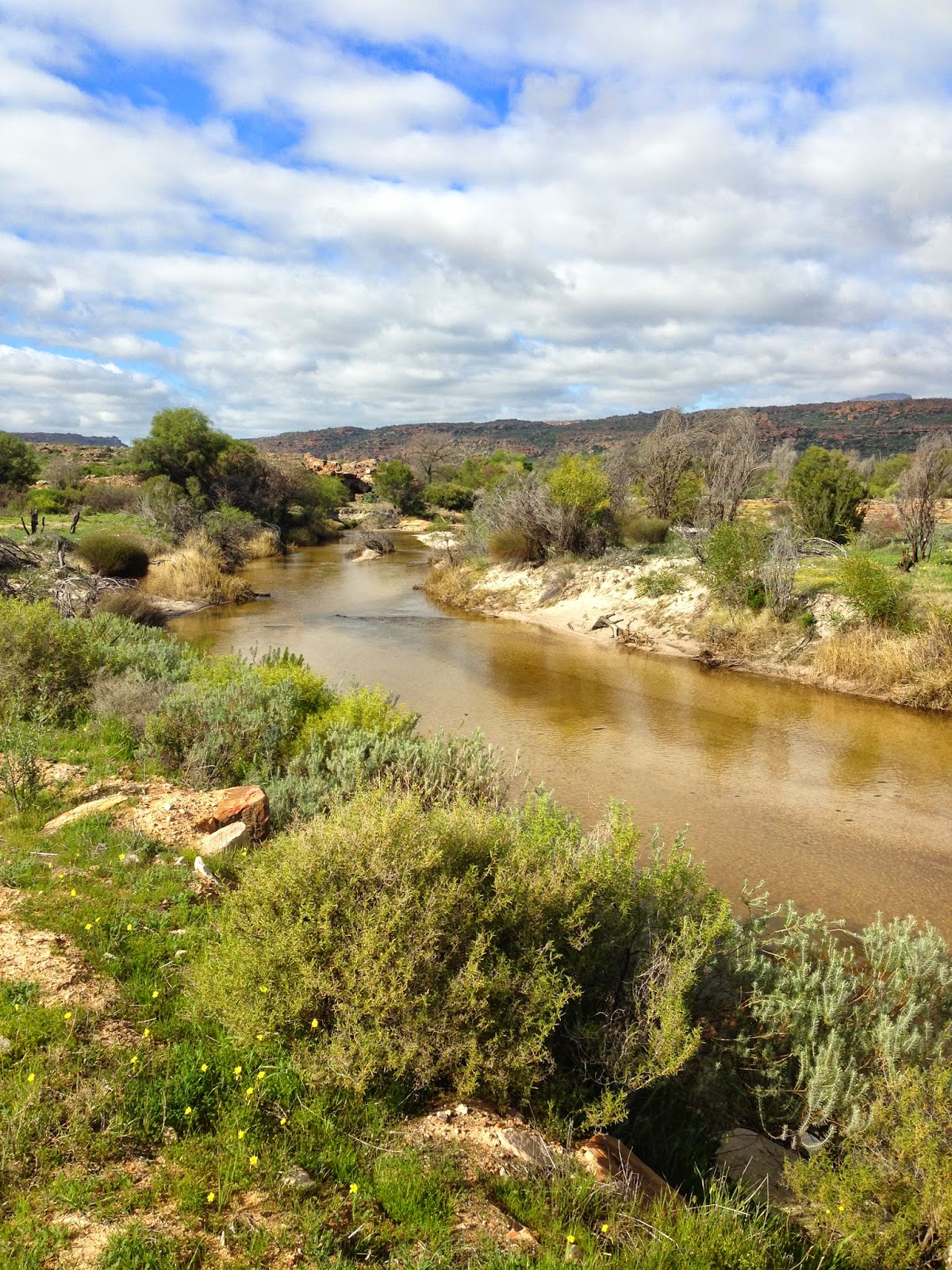
These were the thoughts that passed through my mind as I walked along the Sevilla Trail in the Cederberg mountains, close to Clanwilliam today. Perfect weather for this trail: we wondered if it wasn't going to be too cold, but as we walked, layers of clothing came off. In summer months, we might well have swum in the river.

To get to the Sevilla Trail, you drive about twenty minutes to the east, over the Pakhuis Pass. During the drive, you'll get a good taste of what these robust mountains are about: stark, unexpectedly shaped, randomly balanced: there's something special at work here that did its work millenia ago, and still hovers with presence.

I wondered if you ever heard them from afar, singing, talking. Maybe they were as silent as the plants, but if their paintings are anything to go by, they made all kinds of impressions on their environment.

They have been exterminated. Hunted, shot, killed on purpose, you will find not a real one anymore, yet their legacy is imprinted on the rocks, and their lives still echo from the Brandewyns Rivier.

The starting point is Travellers Rest. There you buy your permit to enter a protected area:ZAR 40 for each of us today. Not too much for locals, nothing for international travellers whose currency laughs at the rand, these days.

We began at the gate made of a sawn-off bakkie railing.


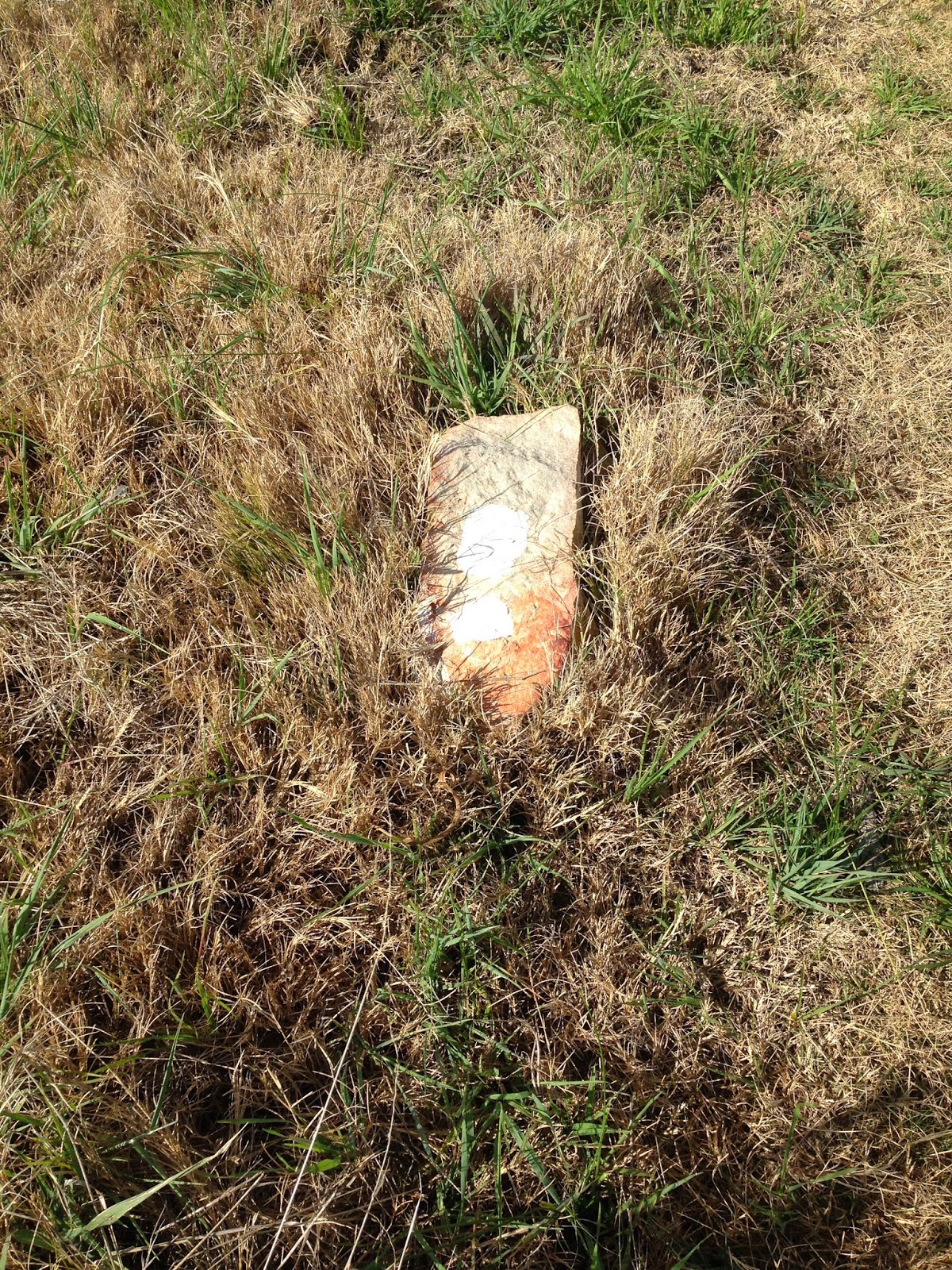
You follow the white footprints. Apparently one year they faded, and a lot of direction was lost. However, today they were clear and bright.


If you are prepared to look for these markers, prepare to lose contact with the present, and to enter a timeless space where ecology, impressions and imagination interact and overlap.

The Sevilla Trail has nine sites of rock art spread over four and a half kilometers. You don't have to walk the whole route. Today we had time only for the first five sites.

The first bit is beside the river, the presence of which resounds much of the trail. No wonder they made home here.


A huge amount of water washed and moved this area millenia ago. The rock formations and sediment attest to this.


After about a kilometer, Site One is well marked. Follow the white footsteps, into pockets of exotica, rock. pond-life and conscious caves where images laugh back at you, defying interpretation.

What were they thinking, following these paths of painting?


On the one hand you have the mystique of rock-framed entrances to another universe, and paths of plants bursting with life.


Then, on the other, the paintings reflect something that brings a more distant past right ino the present focus.


What were they thinking? How did they experience thet magic that moved through the place?


The thing is, walk the trail, enter a world that isn't your normal pattern of knowing and feeling, and come away with with something powerful that an imagination beyond your's has engendered.

That's what makes the difference.


My impression is that the river they heard still runs. No doubt they gave it another name which has long been lost. Nevertheless the sound is similar, no matter the time that has passed.


Sunday, 20 July 2014

On the way: Spring 2014 at Saint du Barrys, Clanwilliam

The weather has been coming and going. The rain means that the fields and pockets of flowers are going to be there, but no-one can predict exactly where. Guests are reminded to have the sun behind them when they look at flowers to get the full benefit. Warmer days like today bring out the flowers, which are remarkable already.

This was taken in the late morning, on our usual walk.


Not bad for a winter's morning. This is a farm dam at the vineyards that surround the cemetery where we walk our dogs. At this time, the vines are bare and pruned, and the town is visible in the background.


The daily maximum temperatures are fluctuating between 13 and 22C, combined with rain or sunshine, as the case may be. The dam is full, and today the Jan Dissels river is running in full spate as well.

And the flowers are out.


These were taken around town today, no further than about one kilometer from Saint du Barrys. At home, the following are shots of our naartjie tree, outdoor detail, and the custodian of conversation at Saint du Barrys, our African Grey known as Ramius the Red October. He is looking forward to hearing from guests, who need to be aware that if he hears the word "Polly" he has been known to shout out "Say something intelligent!"


It promises to be an outstanding spring.


Guests are once again advised that coming from either north or south, there are roadworks from Citrusdal to Clanwilliam and from Klawer to Clanwilliam. The N7 is usually closed on a Tuesday and Thursday between three and four in the afternoon for blasting. It's a good idea to check with the Tourism Office (027 4822024) to be sure of what's happening on these days.

Looking forward to meeting you!


Monday, 30 June 2014

Winter sun in the Cederberg and at Saint du Barrys

For the past few years, we have been travelling in the UK at this time. Not this year. We have had to adjust dthe shape of our year because of additional family members arriving. I have just taken a short walk in the garden and right now have checked the temperature outside. 25C. I still have on a jersey and a jacket because I have been at the computer for much of the morning, and the office is colder than outside because, being a thoroughfare, we don't ligh the fire until we have settled down for the day.

Today is a good day for being outside, for enjoying the warmth and for noticing how nature is replenishing her growth.


Yesterday we decided to pop into the Dam Bistro just fifty meters away for a late breakfast. Sitting in the sun at a warm table was a good idea, but then we had to move to a table in the shade. It was too hot. The winter sun is a wrestler. Clouds, mist and rain contend, and contend well, dominating part of the season, especially when snow on the Cederberg joins in. But when the sun comes out, the other contestants are dazzled while the audience is warmed.

Give it just a couple of weeks, and the flowers will begin to respond, too. Some rain is forecast this coming Friday, a good sign of a floral explosion soon after.


Generally, May, June and July are the quieter months for tourism in the Cederberg area. Yet there is much to be said for turning this way during our winter: you will find very affordable prices, more sunlight than you would have in Europe, good quality of dining if you know where to look, a experience of nature that penetrates (the cold mornings) and pacifies (the later sunlight. The temperature will not drop to freezing. The height above sea-level in Saint du Barys parking area is 52 meters above sea-level.


While you are driving around in the sunshine, there are always the vineyards and the wine route to follow. More information on these will come later.

I recommend a visit at this time, if only for the sake of tasting a flavour of the Cederberg air that our more usual visitors don't. Because there is less fervour and clamour for a yet more vivid experience of the spring flowers, there is more space and intensity, and if you have or make friends amongst the locals, another dimension of social experience can be added. A restaurant that is not abuzz is often deemed to be boring. My experience is that this is when the most curious conversations occur: where people open up not because of the general atmosphere, but because something special is recognized.


Taking the season less travelled can be remarkably rewarding.


Friday, 13 June 2014

The coming winter solstice at Saint du Barrys

Each year at this time, I begin to tell Joan that summer's almost here. The solstice on 21 June is important to me. In the past I have tried to write a poem every solstice and equinox to mark the season. We've had snow, cold days, dull days and sunny days thus far, this winter. Today we noticed daisies in the late morning sun. But it's far too early for flowers yet. This spring should see good flowers; we've had enough rain to raise expectations. The Jan Dissels River has risen a number of times, water is flowing into the Clanwilliam Dam as I write,quite a bit of it from melted snow that we observed a morning or two ago, on the Cederberg peaks to the east of Saint du Barrys, and the town.

 It is our thirteeenth year of living in Clanwilliam and owning Saint du Barrys Country Lodge, and at the risk of nostalgia, I think of all the seasons we have experienced here. If there's one thing that I've come to feel because of living here, it's the ebb and flow of life according to seasons rather than any strict measurement of hours and minutes.The body has a limited memory when it comes to being in the centre of a season. It barely remembers the inertia brought on by February's soaring temperatures when mid-winter throws down its icy stare. The local people like to remark on the particular characteristics of each season.


Sitting in the afternoon sun, at a comfortable temperature of around 20C, I found my gaze settling on a point where air and matter seemed to merge: I could see so much movement of particles in the light, creating spiralling bridges between plants, earth and air-swirls. Yes, one is fortunate to experience life in this way, sitting on the patio, enjoying the left-overs of chilli con carne, naan bread and cold Blanc de Blanc, musing on the details of this season.

Saint du Barrys has seen growth of many kinds: increase in occupancy, staff stability, greater internet presence, family increase, family travel, favourable exchange rates for guests, town developments.

The last elections came and went peacefully, and the most noticeable thing happening around Clanwilliam is the road construction.We lived through construction between Piketberg and the Piekenierskloof Pass, we lived through construction over the pass itself, now we're living and waiting while the section of the N7 between Citrusdal and Clanwilliam is being rebuilt. At the same time, the N7 north of Clanwilliam is also being reconstructed. It's a nuisance but when everything is complete, Cape Town should be no more than two hours away, even less if you ignore the speed cameras at your own peril.

The next construction is to be the dam wall, which has been expected and delayed for years. Once that begins, the value of property on the dam and in the town should increase. New, big changes tend to inspire interest, especially when large areas of water are involved. New playgrounds are always welcome.

Thus, Clanwilliam's climate goes beyond weather. So many little Karoo towns to the east and north-east in the interior have died off. Clanwilliam's heart beats on, quite loudly, when busy days make the main road more like a daring computer game than a traffic thoroughfare. On days like these, tourists are advised to take the main road slowly and carefully, as movement across the road can be more evident than progress up and down the road. The right of way belongs to whoever gets there first. But once the shopping is done, things quiten down, and it's easy to stroll rather than dodge your way while you see what the town has to offer.

Visitors right now are the boulderers, who have waited for the colder weather so that they can grip the rock surface more firmly with finger-tips. Recently we had the dare-devil sport of slack-lining, the one-upmanship that goes beyond the tight-rope.

If you want to see spring flowers, it isn't necessary to wait for August and September. From the first warmer days in July, the flowers make an appearance.

So while we wait to see what happens, we light the fire in our office hearth, choose between a Merlot, Shiraz or Cabernet Sauvignon, and dream about tomorrow's meal.


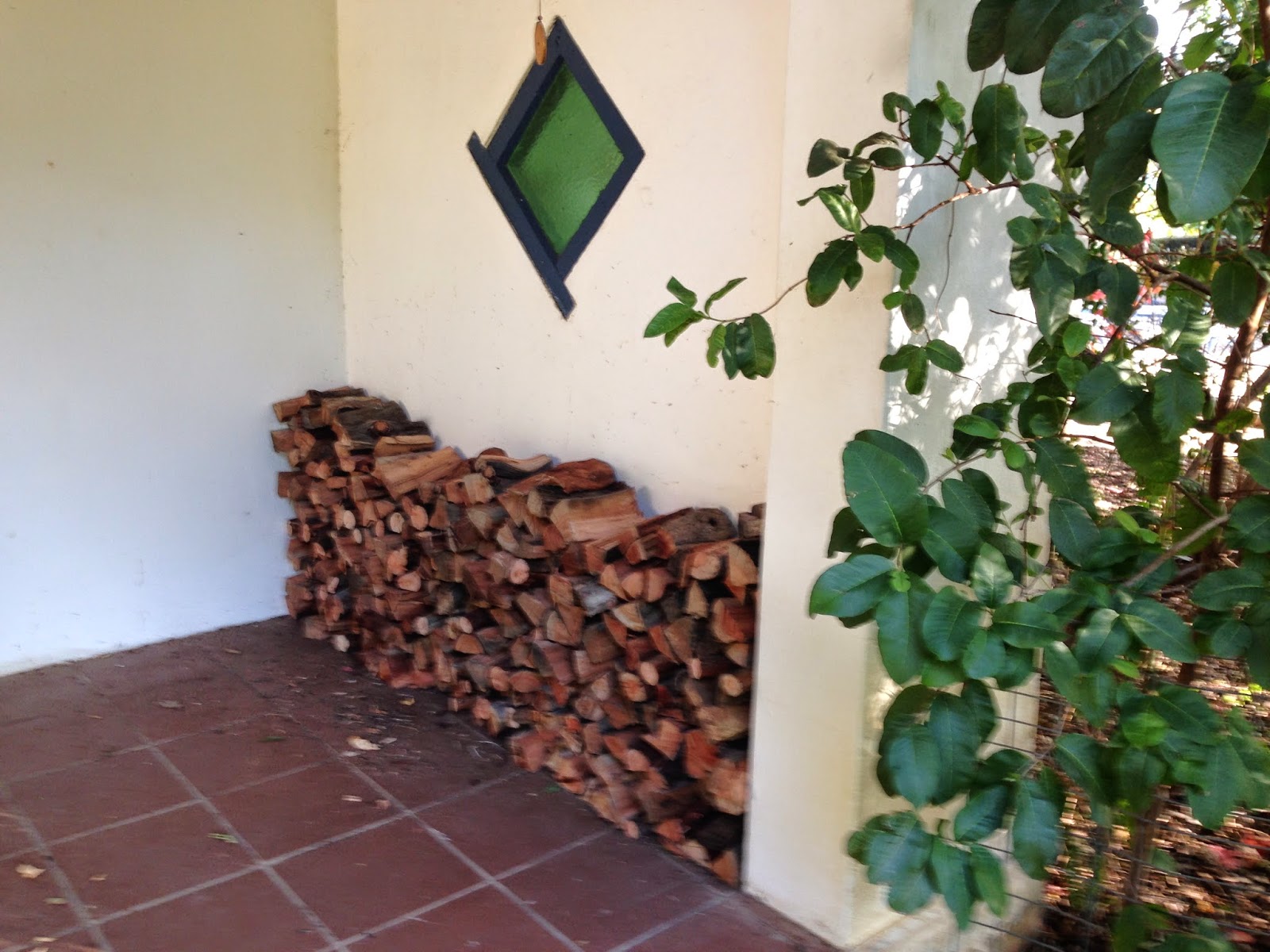
 Five hundred pieces of wood were delivered a few days ago.  They are going down quite rapidly. The height of the pile is a good thermometer to go by.